Seven benefits of Health and Productivity Management certification, and what to watch in the application
Links on this page include advertising.
The Health and Productivity Management Organization certification scheme makes visible the companies that think about staff health from a management point of view and act on it strategically. Awarded to companies practising particularly strong workplace wellness, it is run by the Japan Health Conference.
The scheme is split into a large enterprise category and a small and medium enterprise category, each with assessment criteria suited to that size of company. The top 500 in the large enterprise category are given the title White 500, and the top 500 in the small and medium category the title Bright 500.
Source: https://www.meti.go.jp/policy/mono_info_service/healthcare/kenkoukeiei_yuryouhouzin.html
To be certified as a Health and Productivity Management Organization, a company must carry out effective measures that maintain and improve staff health, then apply and be assessed. Certification is valid for one year, so workplace wellness has to be planned and practised every year.

As the falling birthrate and ageing population shrink the workforce and staff grow older, managing staff health has become a management issue a company cannot do without if it is to keep growing. Workplace wellness is not a benefit but an important management strategy that feeds straight into productivity and attracting people.
TOC
Health and Productivity Management Organization 2024: who was certified, and where things are heading
The number of companies certified rises every year. In Health and Productivity Management Organization 2024, announced in March 2024, 2,988 organisations were certified in the large enterprise category and 16,733 in the small and medium enterprise category.
Compared with 2017, when the scheme started, those numbers show remarkable growth. The small and medium enterprise category in particular has grown around 53-fold from the 318 organisations of the first year.
Source: https://www.meti.go.jp/press/2023/03/20240311004/20240311004.html

Behind the growing number of companies seeking certification lie the shrinking workforce and ageing staff that come with a falling birthrate and an ageing population. Another major factor is the spread of the view that workplace wellness raises company value.
The number of organisations responding to the Health and Productivity Management Survey also rises every year. More than 80% of the 225 companies in the Nikkei Stock Average now respond, and many of the leading companies in each industry treat workplace wellness as part of their management strategy.
The 2024 certification put weight on disclosure, on responding to social issues, and on taking workplace wellness abroad. Particular credit went to disclosing and assessing non-financial information on human capital, and to flexible working that supports childcare, caring for parents, and health issues specific to women.
Source: https://www.meti.go.jp/press/2025/08/20250818001/20250818001.html

Seven benefits of Health and Productivity Management certification
Certification brings a company a range of benefits. Let us look at what they are in detail.
1. A better company image
Certification lets you present yourself outwardly as a company that looks after its people's health. That better image also raises brand value. Certified companies may use a dedicated logo, and showing it on your website, recruitment materials and business cards communicates your work on wellness to stakeholders. It is a particularly strong tool for showing students job-hunting and people looking to move that yours is a good place to work.
2. Financial benefits such as better interest rates
Many financial institutions offer certified companies preferential terms, such as better interest rates on loans or dedicated lending facilities. That can cut the cost of raising funds and make it easier to do so.
The Japan Finance Corporation and regional banks, for example, run special lending schemes for certified companies, with rates below the usual ones. These financial benefits are particularly attractive to smaller companies.
3. An edge in attracting people
Interest in workplace wellness is rising among students job-hunting. A survey by Nikkei Inc. found that a good number of them say a company's work on wellness, or its certification, is decisive when choosing where to work.
As competition for people intensifies, certification is a strong tool for attracting good candidates. Younger people and women in particular increasingly weigh health and quality of working life, and certification gives you an edge in the hiring market.
What workplace wellness does for recruiting: the data on hiring power
4. Higher productivity
When workplace wellness improves staff health, absence falls and work gets more efficient. What deserves particular attention is presenteeism: being at work but unable to perform as you normally would because of how you feel.
Analysis by the Research Institute of Economy, Trade and Industry shows that, among wellness measures, building wellness into the company's stated principles, holding data on staff health, and running work-life balance measures all have a positive effect on profit margins.
5. Access to subsidies
Certification makes it easier to meet the requirements for various subsidies from national and local government. Subsidies for capital spending related to workplace wellness and for introducing staff health programmes are also increasing.
Using them lets you hold down the cost of wellness work while still doing something effective. For smaller companies in particular, it is a real help in pushing wellness forward on a limited budget.
6. Extra points in public procurement
Some local authorities award extra points to certified companies in public procurement and tenders. That can mean more public work.
Public work is a stable source of revenue, so this is a significant benefit for industries where it makes up a large share, such as construction and information services. Certification becomes a competitive advantage in bidding.
7. Discounts on insurance premiums
Some insurers offer certified companies preferential terms such as discounts on group insurance premiums or special plans. That can cut a company's insurance costs.
Better staff health also lowers medical spending, which improves the finances of the health insurance society and, over the long run, should ease the burden of health insurance premiums.
Obstacles on the way to certification, and what to do about them
Certification brings many benefits, but there are obstacles on the way. Understanding them and dealing with them properly matters.
1. The difficulty of getting it into data, and of showing the effect
The effects of workplace wellness are hard to put into numbers and slow to show. Smaller companies in particular often lack the know-how and the resources to collect and analyse health data.
One answer is to use the health data analysis services offered by health insurance societies and the Japan Health Insurance Association, or to collect data regularly by simpler means such as staff surveys. Measuring indirect indicators alongside them, such as improvement in presenteeism and staff satisfaction, lets you show the effect from several angles.
2. Dealing with the cost
Workplace wellness costs not only the measures themselves but the application fee and the people's time. The 2024 application fee was 80,000 yen (88,000 yen including tax) in the large enterprise category and 15,000 yen (16,500 yen including tax) in the small and medium enterprise category.
On cost, the important thing is to start with measures that are cheap to run. You might begin with things that need no capital spending, such as regular walking events or encouraging people to use the stairs. Making active use of the subsidies and preferential lending mentioned above can ease the burden further.
3. Winning understanding and cooperation inside the company
Wellness work sometimes meets resistance or indifference inside the company, along the lines that it is unnecessary or gets in the way of the job. Where the gap between leadership and the shop floor is wide, measures struggle to take hold.
The way through is to explain carefully inside the company what workplace wellness is for and what it should achieve, and to build understanding. A message from leadership, together with a wellness lead in each department, works well as an approach from the top and the bottom at once. Enjoyable events that people want to join of their own accord, and incentives for taking part, will also raise interest and participation.
How to apply for certification, and what the assessment looks at
Certification requires a set application process. Here we cover how to apply and what the assessment weighs.
The process differs between the large enterprise category and the small and medium enterprise category. The large enterprise category requires a response to the Health and Productivity Management Survey; the small and medium category requires submission of an application form.
The process and the documents you need
For the large enterprise category, you respond to the Health and Productivity Management Survey and fill in the application section of that same survey. For the small and medium category, you first take part in the health declaration scheme run by your insurer, such as your prefectural branch of the Japan Health Insurance Association, then prepare and submit the application form.
An application fee is payable. The 2024 fee was 80,000 yen (88,000 yen including tax) in the large enterprise category and 15,000 yen (16,500 yen including tax) in the small and medium enterprise category. Applying jointly with group companies incurs an additional charge.
What the assessment weighs
The assessment puts weight on points like these.
First, that workplace wellness has a clear place in the company's stated principles and policy. Credit goes to leadership recognising that it matters and saying so inside and outside the company.
Next, that health issues have been identified and the measures they call for considered. Raising the take-up of health checks and providing health guidance on the results are assessment points. Promoting work-life balance, mental health measures and measures against passive smoking are important too. These have to be done systematically and continuously.
It also matters to have a PDCA cycle in place for assessing and improving the work. Credit goes to having a way of measuring the effect and feeding it into improvement. When applying, working with these points in mind and setting out what you have done concretely on the form is the key to being certified.
Workplace wellness in practice with Yasai Yakuzen
Effective workplace wellness means understanding staff health and putting the right measures in place. Here we introduce workplace wellness in practice using Yasai Yakuzen, which is grounded in Chinese medicine.
Yasai Yakuzen is a health support programme that combines the wisdom of Chinese medicine with a practical way of eating built on everyday vegetables. Because it uses vegetables from any supermarket rather than special kampo ingredients, anyone can keep it up without strain.
Meeting the health issues companies face today
In workplaces today, lost productivity through presenteeism, where people are at work but with concentration and judgement below par, is a major issue. Consideration for health issues specific to women, such as PMS, the menopause, feeling the cold and constipation, is expected too.
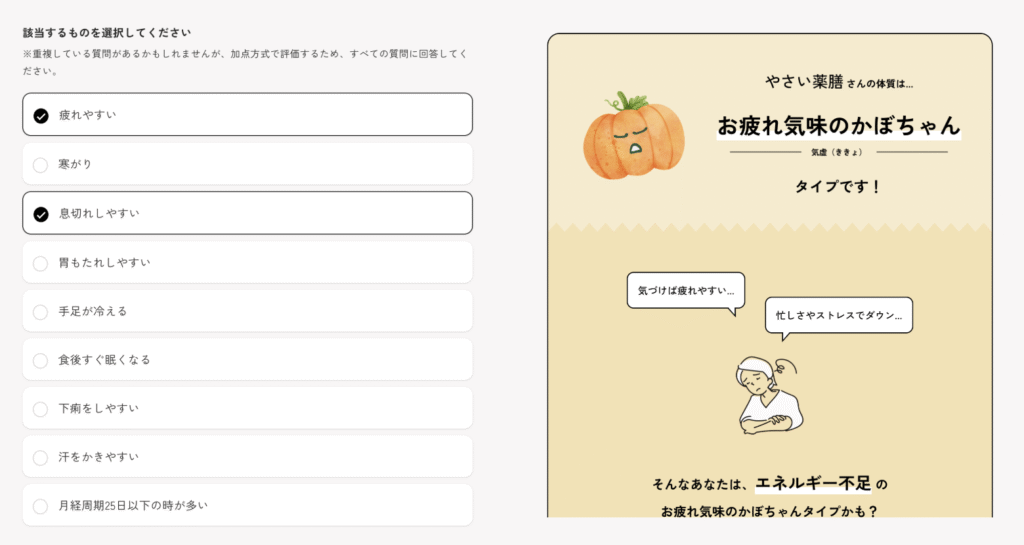
The Yasai Yakuzen programme answers these with an approach that pairs data with better eating to make things visible and support them. A constitution check of seven questions makes staff constitutions visible, and a one-to-one chat with a yakuzen practitioner covers everyday complaints.
Support towards certification
The corporate Yasai Yakuzen programme offers staff the check, a chat about how they feel and suggestions for eating better, and analyses and visualises health by team. That also helps build the evidence needed towards Health and Productivity Management certification, including the White 500.
The online learning programme, 40 videos in all, is built from three-minute videos that busy working people can get through, and suits reskilling around food. Through these the programme raises health awareness among staff and encourages concrete changes in behaviour.
For a company aiming at certification, the Yasai Yakuzen programme is an effective tool. What marks it out is that it comes at vaguely feeling off, a state healthcare struggles to address, through food.
In summary: certification opens up a future for company and staff alike
Health and Productivity Management certification assesses and certifies companies that manage staff health strategically from a management point of view. Certification brings a better company image, financial benefits, an edge in attracting people and higher productivity, among much else.
The announcement in March 2024 certified 2,988 organisations in the large enterprise category and 16,733 in the small and medium enterprise category, and the numbers rise every year. That is evidence that workplace wellness has come to be seen as essential to a company's sustained growth. There are obstacles on the way to certification, but they can be overcome with the right approach. Making data visible, dealing with the cost, and building understanding inside the company are the key points.
The assessment weighs the place of wellness in the company's stated principles, the identification of health issues and the measures taken, and the promotion of work-life balance. Working with these points in mind and setting them out concretely on the form is the key to being certified.
Using an effective programme such as Yasai Yakuzen lets you make staff health visible and improve it, and smooths the path to certification. Workplace wellness is not a benefit but an important management strategy for sustained growth and competitiveness. Let us aim for certification and build a future where company and staff alike can be well and do their best work.
For more on the Yasai Yakuzen programme and what it does for workplace wellness in practice, see Workplace wellness built on vegetables and yakuzen. We will propose the solution that best fits your staff's health issues.
Related articles
-
 How workplace wellness connects to the SDGs: five points where they meet
 -
Six steps for a mid-sized company starting workplace wellness: getting the most from what you spend
-
What workplace wellness does for recruiting: the data on hiring power
-
Femtech literacy makes a company stronger: a new angle on workplace wellness
-
How workplace wellness changes the future for women at work: the front line of employee benefits
-
How to head off the health risks that come with remote work: the case for wellness at home
-
Seven eating habits for staying healthy while working remotely, and the traps to avoid
-
Health issues for women at work and what actually helps: the moves that raise company value