How yakuzen sees ingredients
Links on this page include advertising.
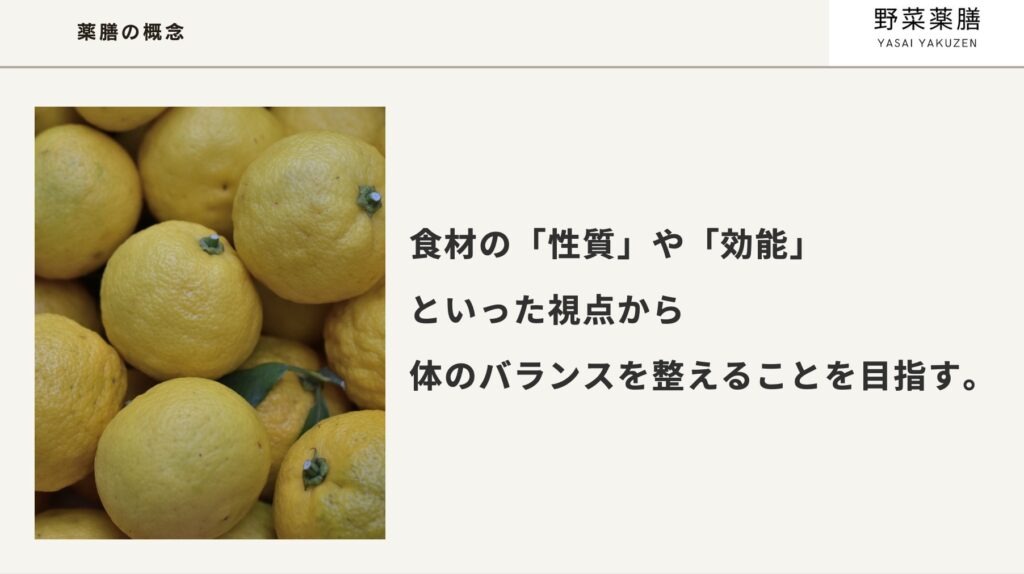
Yakuzen looks at ingredients not simply as nutrients but at their qualities and at what they do, with a view to keeping the body in balance. That approach lets you understand how an ingredient acts on the body and choose what you eat to better effect. Here we set out how yakuzen sees ingredients in detail.
1. The nature of an ingredient (the four natures)
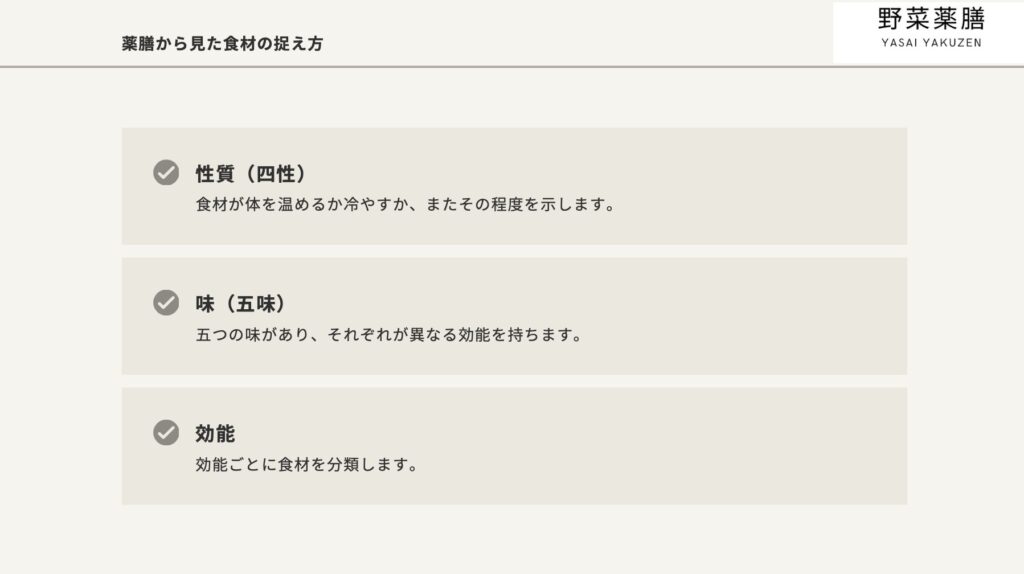
In yakuzen, ingredients have what are called the four natures. This is the measure of whether an ingredient warms or cools the body, and by how much. The four are as follows.
- Warm (warming): ingredients that warm the body and help circulation. They suit anyone who feels the cold, and the winter season. Examples: ginger, garlic, spring onion.
- Hot (strongly warming): ingredients that warm the body more strongly than warm ones, clearing cold from inside. Examples: chilli, lamb.
- Cool (cooling): ingredients that cool the body and settle inflammation. They suit a constitution where heat builds up, and the summer heat. Examples: cucumber, tomato, tofu.
- Cold (strongly cooling): ingredients that cool the body more strongly than cool ones and are better at clearing heat. Examples: watermelon, hard clam.
Understanding the four natures lets you choose ingredients to suit your constitution and the season, and keep things in balance.
2. The flavour of an ingredient (the five flavours)
Flavour plays an important part in yakuzen too. Ingredients fall into five flavours, each with different effects.
- Sweet: replenishes energy and helps you relax. It calms the body and brings things into balance. Examples: rice, kabocha squash, banana.
- Sour: gathers in the body's energy and tightens muscles and tendons. It helps digestion and recovery from tiredness. Examples: umeboshi, lemon, apple.
- Bitter: cools the body and settles inflammation and heat. It also guards against dryness. Examples: bitter melon, coffee, green pepper.
- Pungent: encourages sweating and improves circulation. It helps keep colds off and gets things moving. Examples: ginger, chilli, garlic.
- Salty: softens the body and clears waste. Examples: salt, seaweed, shellfish.
Keeping the five flavours in mind and bringing them in, in balance, lets you eat to suit how you feel.
3. What an ingredient does
Yakuzen also looks at what an ingredient does. Each one, by its own qualities, works on different parts of the body and different complaints. These are some of the categories.
- Replenishing qi: ingredients that build energy and support a body that tires easily. Examples: carrot, soybeans, chicken.
- Replenishing blood: ingredients that build the blood and ease anaemia and feeling the cold. Examples: spinach, liver, black sesame.
- Clearing heat: ingredients that cool excess heat in the body. Examples: cucumber, celery, green tea.
- Getting blood moving: ingredients that improve the circulation of blood and clear what is stuck. Examples: black vinegar, ginger, cinnamon bark.
Understanding what ingredients do this way lets you choose food to suit how you feel, and gives you something to work with in heading off pre-illness and in feeling better.
In summary
How yakuzen sees ingredients is about understanding deeply what they do to the body, not only their nutritional value. Looking at an ingredient's nature, flavour and effects lets you eat in better balance and supports settling how you feel. Put what you know of yakuzen to work, make a point of choosing ingredients for your constitution and the season, and make more of what you eat every day.
Related articles
-
 What is yin-yang theory in yakuzen?
 -
What is five-phase theory? The idea at the root of Chinese medicine
-
What are qi, blood and fluids in yakuzen?
-
[Updated 2025] Easy yakuzen recipes from everyday ingredients, and how to work them into your life
-
Why yakuzen is drawing attention from busy men today: three effects and how to practise it
-
How I started a business through yakuzen: what I would tell you
-
Starting a side business with yakuzen: the road from no experience to income
-
Nine tips for keeping yakuzen going, and how to make it a habit