The benefits of mugwort
Links on this page include advertising.
 What mugwort does
What this vegetable does
It is said to encourage the flow of blood and to help with feeling the cold.
How to eat it
Good blanched and dressed, in tempura, or as a tea.
A yakuzen note
It is held to warm the body and to settle the circulation of the blood.
Mugwort is a warm wild plant held to warm the body from the core, encourage the flow of blood and settle the trouble that comes from cold. Working through the meridians, it is looked to for settling the circulation within the body and for stopping bleeding, and is said to suit heavy bleeding during a period, blood in the stool and haemorrhoids. It is an ingredient easy to bring in for those who feel the cold and for the care of women.
TOC
When mugwort is in season, and how to prepare the young leaves
If you want to enjoy what mugwort does at the everyday table, start with its season and how to prepare it. Mugwort has long been a familiar wild plant, and knowing how to pick it and how to take the harshness out gives a fragrant result. Taste the softness and the particular scent that belong to the young leaves of spring.
Mugwort is in season in spring, from March to May
Mugwort is at its best in spring, around March to May. The young leaves just up from the ground are soft, and their scent is gentle and easy to eat. The main growing areas are Nagano, Kyoto and Kumamoto, with Tokushima among the places growing it for processing, and it grows wild in hills and fields across the country. As the season goes on and the leaves grow, both the scent and the harshness grow stronger. If you pick it, choose the soft new shoots. As a leafy green containing dietary fibre, it also sits easily on a healthy spring table. Avoid plants at the roadside or the edge of a field, anywhere with a lot of passing traffic, and pick in clean places.
How to pick the young leaves, and how to tell mugwort from ragweed
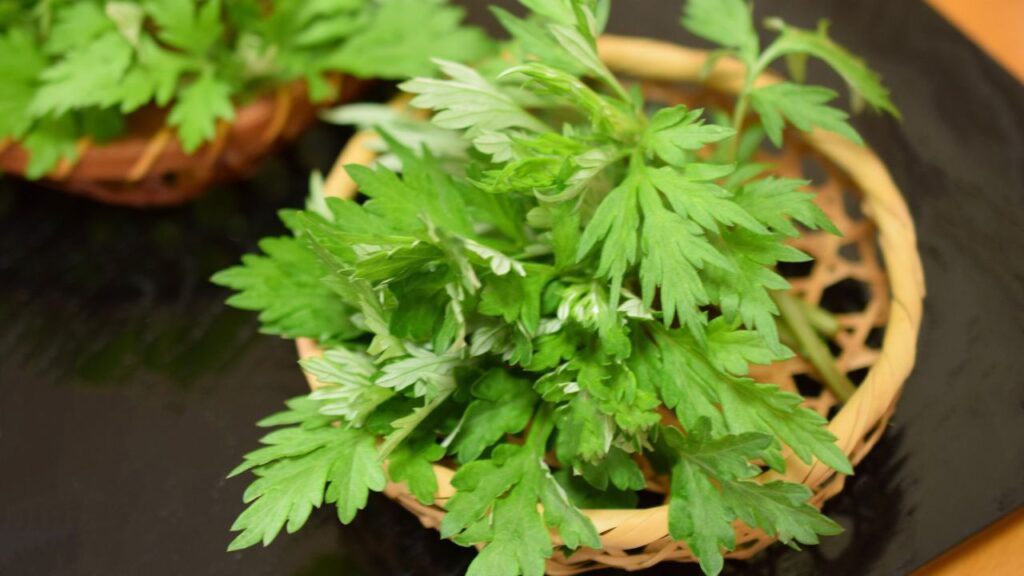
When picking mugwort outdoors, telling it from the plants that look like it matters. The underside of a mugwort leaf is covered in white down, and rubbing a leaf lightly brings up the fresh scent particular to mugwort. That scent comes from a substance called cineole. Ragweed, which is similar in shape, has almost no scent and no white on the underside of the leaf. When in doubt, check the scent and the colour of the leaf's underside and you are on safe ground.
How to take the harshness out with bicarbonate of soda
Mugwort is strongly harsh, so blanch it to take the harshness out before cooking. The method is simple.
- Bring plenty of water to the boil and add a pinch of bicarbonate of soda
- Blanch the mugwort quickly and drop it into cold water to set the colour
- Squeeze the water out and chop it, or grind it to a paste
Bicarbonate of soda gives a vivid colour and softens the harshness. Overboiled the scent goes, so a brief pass through the water is the way to go.
How to eat mugwort
Mugwort goes widely into Japanese cooking that plays to its flavour. It is familiar not only in sweets but in dishes and drinks. Here are the main recipes using prepared mugwort.
Mugwort mochi and kusamochi, a taste of spring
Kusamochi and yomogi mochi are what many people think of first when mugwort is mentioned. Mugwort blanched, ground and worked into freshly pounded mochi or dango gives a vivid green and a scent of spring. Wrapped around sweet bean paste, or dusted with kinako, it is easy enough to make at home. Kusamochi is familiar as a sweet for Tango no Sekku and for spring occasions, and the name changes by region, kusamochi in the east and yomogi mochi in the west. Powdered Mugwort powder need only be mixed into shiratamako or joshinko to make a seasonal Japanese sweet, and added to pancake or muffin batter it gives you the flavour there too.
Tempura and blanched dishes, a taste of spring
The soft young leaves are at their most fragrant in tempura, which suits a spring table. Batter them thinly and fry them quickly and the colour and flavour of the mugwort come through. Blanched mugwort can also be served dressed with stock or soy sauce, in a dressed dish or in miso soup. Dressed with tofu, the light bitterness of the mugwort sits well with the richness of sesame. Mixed into rice as yomogi gohan, it brings colour too.
Mugwort tea and how to use the dried leaves
Dried mugwort can be simmered out as mugwort tea. Gentle in flavour and free of caffeine, it drinks easily at any time of day, and blended with hojicha or genmaicha the scent comes forward. It suits a cup after a meal. Dried mugwort keeps, and beyond tea it can go into baking and furikake. If drying your own is difficult, Japanese Dried mugwort is an easy way to bring it into tea and into Japanese sweets. Boiling it, squeezing out the water and freezing it in small portions is handy as well.
Plenty of uses beyond food
Mugwort is not only eaten; it has been used in all sorts of ways in daily life. The white down gathered from the underside of the leaves is the raw material for moxa, used in moxibustion. Dried leaves put into hot water make a mugwort bath, a known way of bringing it into bathing. At Tango no Sekku there is a custom of hanging it at the eaves along with iris, and it has long been used to mark the turn of the seasons and to ward off ill fortune. Across the sea in Europe it is a familiar herb known as mugwort, at home in daily life east and west alike.
Likewise familiar as an ingredient that warms the body, The benefits of ginger or The benefits of cinnamon, one held to nourish qi and blood, The benefits of jujube is worth knowing alongside it, as a guide when planning a seasonal menu.
Coming into leaf in early spring, mugwort is a wild plant whose appeal is the scent and softness of its young leaves. As mugwort mochi, as tempura, as tea and in the bath, it can be enjoyed widely in everyday life. In its season, bring the scent of spring to the table.