The benefits of daikon radish
Links on this page include advertising.
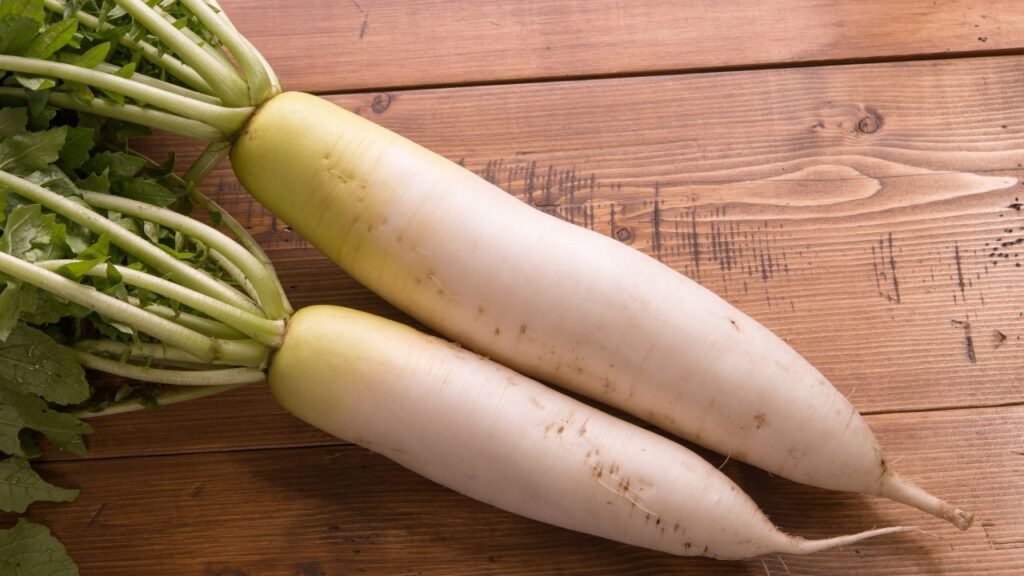 What daikon does
What this vegetable does
Held to settle the circulation of qi and draw it downwards.
How to eat it
Simmered or grated, it is a way of cooking that is kind to the gut.
A yakuzen note
Held to ease what has stalled. Good when a blocked or heavy stomach, or a bloated abdomen, is on your mind.
This vegetable, driedDried Shogoin daikon →
Daikon settles the circulation of qi and is used for a blocked feeling, coughs, hiccups and tightness in the chest. It also suits symptoms with heat in them, such as yellow or sticky phlegm, and its cool nature helps settle a sense of heat.
TOC
When daikon is in season, and using each part and variety
If you want to bring in what daikon does, deliciously, knowing the season and how the taste differs by part makes it easier to choose. Within a single daikon, sweetness and heat change from top to bottom, and different varieties suit different dishes. It is at its best from winter into early spring, when juiciness and sweetness stand out.
Daikon is in season from winter into early spring
Daikon is most widely in the shops in winter, roughly November to February. The main producing areas are Hokkaido, Aomori and Chiba, and cold weather makes daikon sweeter. Suzushiro, one of the seven herbs of spring, is the daikon, and it has long been a familiar vegetable at the Japanese table.
- Choosing — a smooth, taut surface and a good weight. Juicy leaves mean freshness
- Keeping — cut off the leaves, wrap it in newspaper and keep it somewhere cool and dark or in the vegetable drawer. Left on, the leaves draw water from the root
- What to use first — start with the sweet top and keep the hotter lower part for garnishes
It is a vegetable you often cut up and use over time, so separating leaves and root soon after buying makes it last.
Sweetness and heat differ by part
The taste of a daikon changes a great deal from part to part. Using each for the dish at hand draws out what it has.
| Part | What the taste is like | Dishes it suits |
|---|---|---|
| Top (the leaf end) | High in water and sweet | Salads, grated daikon, light pickles |
| Middle | A good balance of sweetness and heat | Simmered dishes, oden, furofuki |
| Bottom (the tip end) | Strongly hot | Grated as a garnish, miso soup, stir-fries |
Remember the top when you want it sweet and the bottom when you want a sharp garnish, and you can use a whole daikon from end to end.
Shogoin, Miura and other leading varieties
Daikon has distinctive varieties in each region. The one most often seen in supermarkets is the juicy aokubi daikon, but the traditional vegetables of Kyoto include the round Shogoin daikon, which is fine-grained and holds its shape, so it suits simmering. Kanagawa's Miura daikon has a distinctive shape, thickening from the middle towards the tip, with dense flesh that holds its shape even when stewed. Kagoshima's Sakurajima daikon is known as the largest daikon in the world, with a solid, dense flesh. Karami daikon is small and strongly hot, and grated as a garnish for soba it brings the flavour forward. The background of traditional vegetables rooted in each region is also covered in traditional vegetables across Japan. Choosing by variety to suit the dish is a pleasure in itself.
How to eat daikon
Daikon can be enjoyed raw or cooked, and how you cook it changes both its heat and its texture. Here are ways to eat it that fit easily into everyday cooking, from grated daikon to simmered dishes to using the leaves and skin.
How to adjust the heat of grated daikon
The heat of grated daikon can be changed by how you grate it. What makes it hot is produced when the cells break, so the grating changes the taste. Freshly grated daikon is at its most fragrant, so when you want the heat and the aroma, grate it just before eating.
- To make it milder — use the sweet top and grate gently, in circles
- To make it hotter — use the bottom and grate firmly, across the fibres
- Dishes it suits — as a garnish for grilled fish and fried food, mizore nabe, dressed nameko
With chirimenjako or whitebait, it makes a dish that has you reaching for rice.
Gently, in simmered dishes and soups
Cooked, daikon's sweetness comes forward and it softens in the mouth. For oden and furofuki daikon, parboiling it in the water from washing rice draws out the harshness, and using a variety that holds its shape, such as Shogoin, gives a neat result. In buri daikon the savour of the fish soaks into the daikon, and simmered with pork belly it makes a rich dish. Dishes that let it take up dashi or a simmering liquid are what the winter table cannot do without.
Using the leaves and skin too
Not only the root but the leaves and skin of daikon are good to eat. Daikon leaves are nourishing; chopped fine, fried in sesame oil with chirimenjako and sesame added, they make a furikake to keep. In a miso soup they add colour too. The skin, cut into fine strips for kinpira, or salted for a light pickle, gives a crisp texture to enjoy. Use the fibre-rich skin and leaves and there is almost nothing to throw away.
Drying to draw out the savour: kiriboshi daikon
Dried, daikon loses water and its sweetness and savour concentrate, giving a taste quite different from fresh. Kiriboshi daikon can be rehydrated for simmered dishes, harihari-zuke and salads, and is handy to keep in the cupboard. The soaking water carries sweetness and savour, so using it in a simmering liquid or as stock for miso soup means nothing is wasted. When drying it yourself is hard, a dried product such as Kyoto-grown dried Shogoin daikon makes a dish of it with nothing more than rehydrating. Warihoshi daikon, made by drying it for about half a day in the sun, keeps its bite and suits stir-fries too.
Ingredients in season in winter are also covered in The benefits of Japanese yam or The benefits of chestnut, The benefits of kabocha squash. Read them together as a guide to planning a seasonal menu.
The sweet top when raw, the bottom when you want heat, Shogoin for simmering. Choose by part and by variety and bring daikon to your winter table. From root to leaves, skin and kiriboshi, it is a vegetable where every part has something to give.