The benefits of daylily buds
Links on this page include advertising.
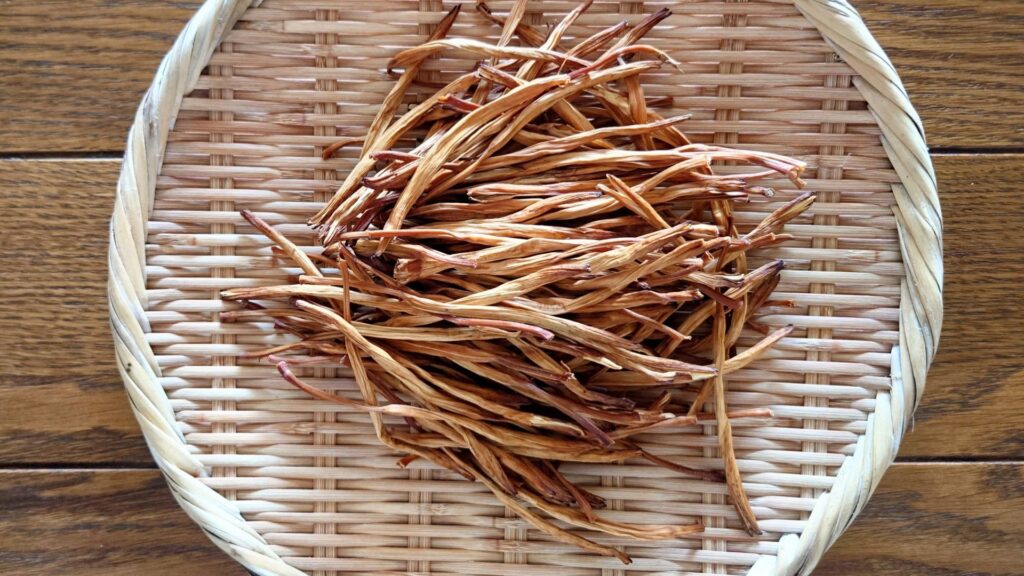 What golden needle flowers do
What this vegetable does
Held to clear excess heat from the body and, by encouraging the passing of water, to drain excess fluid.
How to eat it
Blanch it briefly for a salad or ohitashi; it also suits soups and stir-fries.
A yakuzen note
A vegetable held to clear damp-heat and settle the balance of water in the body.
Daylily bud is a sweet ingredient, cool in nature, held to settle excess heat and damp trapped in the body, nourish the blood and settle the mind. It uses the buds of the daylily, and the dried form is widely sold. It suits daily care in the damp seasons, or when you feel unsettled, and it is the yellow ingredient familiar from Chinese cooking.
TOC
When daylily buds are in season, the kinds, and how to choose
If you want to bring in what daylily buds do, deliciously, knowing the season, the kinds and how to choose makes them easier to use. Their appeal is a vivid yellow and a firm bite, and they are a Chinese ingredient long loved in yakuzen.
Made from daylily buds, mostly sold dried
Daylily bud is the unopened flower bud of the daylily, eaten as food. Fresh buds are in season in summer, roughly June to August, but few reach the shops, and dried daylily bud is widely used as a Chinese ingredient all year. It is also written with characters read koukasai, and China has long used it in yakuzen. The dried form needs only water and keeps, which makes it handy to have in the cupboard. Fresh buds are sometimes found at farm shops in the growing areas in season.
Dried and fresh daylily buds
Daylily bud can be chosen by the form you use.
| kinds | What stands out |
|---|---|
| Dried daylily bud | The most common. Rehydrated, for soups and stir-fries |
| Fresh daylily bud | Buds available only in summer. A firm bite. Always cook it |
| For yakuzen soups | As a yakuzen dried ingredient, paired with jujube and goji berry |
For ease, dried daylily bud, available any time, is handy. Fresh buds give a taste that belongs to summer alone. Fresh or dried, the rule is never to eat daylily bud raw; always cook it. Paired with jujube and goji berry, it makes a yakuzen soup of fine colour.
How to choose it and how to rehydrate it
When choosing good daylily bud, these points make it easier to tell.
- Dried: a natural yellow-brown, not unnaturally deep in colour
- Even in shape, well dried and not damp
- Fresh: tight buds, juicy and new
Soak dried daylily bud in lukewarm water for 20 to 30 minutes before use. Once rehydrated, remove the hard base and cut any long pieces to an easy size. Tying them in a knot before simmering keeps them from falling apart and looks neat. Daylily bud is not eaten raw; cooking it thoroughly is the rule. The soaking water carries flavour, so using it in a soup means nothing is wasted.
How to eat daylily buds
Daylily bud works widely in soups and stir-fries, drawing on its firm bite and vivid yellow. Here are the standard ways.
In soups and yakuzen soups
What brings out the most in daylily bud is a soup. Rehydrated and added to a chicken or pork soup, it gives a firm bite and a faint sweetness. In hot and sour soup, sour and spicy, it is an essential ingredient alongside wood ear and tofu. A yakuzen soup simmered with jujube, goji berry and ginger is beautiful in colour and suits times when you want to be kind to the body. Using the soaking water too lets you enjoy its flavour with nothing left behind.
In stir-fries, with egg, and dressed
Daylily bud goes well in stir-fries too. Stir-fried with pork and wood ear, Chinese-style, it is a standard where the differences in texture are the pleasure. Fried softly with egg, or with Chinese chives, it finishes well in colour. Rehydrated, cooked briefly and dressed with sesame oil and soy sauce, it is exactly right as a palate-cleanser. It suits Japanese cooking as well as Chinese and helps when you want one more dish. Its vivid yellow lifts the colour of a plate.
How to keep daylily buds
Dried daylily bud keeps, but it loses flavour and moulds easily if it takes up damp, so keep it in an airtight container or bag with a sachet of desiccant, somewhere cool and dark away from damp. In humid seasons, the fridge is safest. Rehydrated daylily bud spoils easily, so use it the same day or rehydrate only what you need. If you rehydrate more, drain it and freeze it in portions, ready for soups and stir-fries.
Alongside this, it is worth knowing about The benefits of jujube likewise used in yakuzen soups and held to nourish the blood, and what is used with it in Chinese cooking, The benefits of black wood ear mushroom as a guide when cooking yakuzen dishes.
Daylily bud, enjoyable all year in dried form, is a Chinese ingredient whose firm bite and vivid yellow you can enjoy in soups, yakuzen soups, stir-fries and dishes bound with egg. Easy dried buds and fresh summer-only buds: using each form for what it does best brings out what it has. Never eat it raw; cook it thoroughly, and bring daylily bud in for daily care in the seasons when damp settles in.