The benefits of grapes
Links on this page include advertising.
 What grapes do
What this vegetable does
Said to replenish qi and blood and to ease swelling by encouraging the passing of water.
How to eat it
Eat them as they are, or in juice, jelly or a salad.
A yakuzen note
They replenish qi and blood, and are held to be worth eating when you feel tired or heavy.
Grapes are a fruit where sweet and sour sit in harmony, held to replenish qi and blood and strengthen the muscles and bones. They also encourage the passing of water, which can be looked to for easing swelling and a sense of heat in the body. They suit easing tiredness and anaemia in particular, and bringing them into everyday meals helps you get your energy back.
TOC
When grapes are in season, the varieties, and how to choose
If you want to bring in what grapes do, deliciously, knowing the season, the varieties and how to choose makes them easier to choose. With a juicy sweetness and a character of their own in each variety, they are the fruit that stands for autumn.
In season from late summer into autumn
Open-field grapes are in season roughly August to October, and September and October in particular are their autumn peak. The main producing areas are Yamanashi, Nagano, Okayama and Yamagata, with Yamanashi known for growing more than anywhere in Japan. Small-berried varieties such as Delaware appear from early summer, under glass and through early and late varieties, while Kyoho and Shine Muscat are at their best from the end of summer into autumn. Because varieties come in at different times, grapes can be enjoyed over a long stretch.
Telling varieties apart by colour
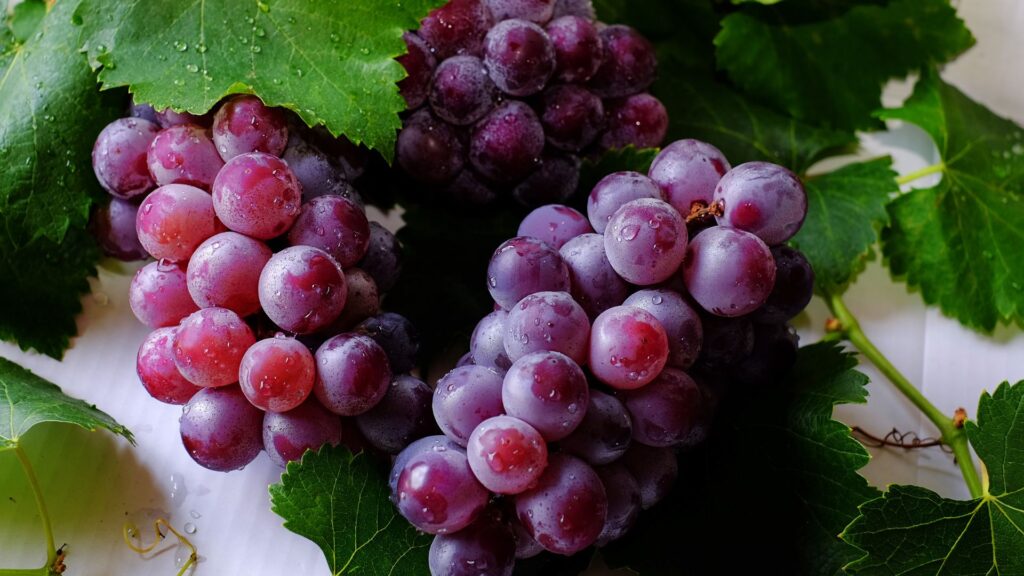
Grapes fall broadly into three groups by skin colour, each with its own character.
| Group | Leading varieties | What stands out |
|---|---|---|
| Black | Kyoho, Pione, Nagano Purple | A rich, deep sweetness |
| Red | Kaiji, Queen Nina, Delaware | A refined sweetness and aroma |
| Green | Shine Muscat, Seto Giants | Fresh, and easy to eat skin and all |
In recent years, seedless varieties you can eat skin and all, such as Shine Muscat and Nagano Purple, have increased. No peeling, and you get the flavour near the skin too, which is why they are popular. Black for a deep sweetness, green for something clean: choose by taste and by use.
How to choose them, and spotting the bloom
When choosing good grapes, these points make it easier to tell a fresh bunch.
- A green, firm stem, not shrivelled
- Berries tightly packed, taut and well coloured
- A white powder, the bloom, on the surface
The white powder on the berries is called bloom. It is not a pesticide but a natural substance the grape produces to guard against drying and damage. An even bloom is a sign of freshness, so rather than washing it off, wash the grapes just before eating. If the berries at the tip of the bunch, lowest down, are sweet too, the whole bunch is ripe.
How to eat grapes
Grapes are good eaten as they are, of course, and a little thought widens the pleasure. Here are ways to use their juicy sweetness.
As they are, skin and all, or frozen
Varying how you eat them by type draws out what they have.
- Varieties you can eat skin and all: rinse and eat straight away
- Varieties you peel: a shallow cut opposite the stem end and the skin slips off
- Well chilled: the sweetness comes forward, exactly right in hot weather
In many varieties the aroma is strongest near the skin, so where you can eat the skin, eating it is what to aim for. Freezing a glut is covered under keeping them, below.
In juice, salads and confectionery
Blended, grapes make a rich home-made juice or smoothie. Halved and combined with yoghurt, a green salad or cured ham, their sweetness and acidity give an accent. They suit compote, jelly, tarts and other confectionery, and used skin and all they keep their red and purple colour beautifully. Dried as raisins, they work widely in bread, baking and as a hidden note in cooking, and how to choose dried fruit is worth reading alongside.
How to keep grapes
Grapes bruise easily on the bunch, so take off only what you will eat. To keep them, put the unwashed bunch in a plastic bag in the vegetable drawer of the fridge; the bloom stays and they last. When taking berries off one by one, cutting them with a little stem left keeps the cut from spoiling. If you cannot eat them all, wash them, wipe them dry, put them in a freezer bag and freeze them, and they keep about a month. Frozen grapes can be eaten straight from frozen like a sorbet, or floated in a drink, which suits hot weather. Ones frozen with the skin on peel cleanly under a little running water.
Alongside this, it is worth knowing about The benefits of jujube likewise held to replenish blood, and one in season in autumn, The benefits of pear as a guide when building an autumn table.
Grapes, in season from late summer into autumn, differ in colour and taste by variety. Black for a deep sweetness, green when you want to eat them clean and skin and all, and the bloom as your mark of freshness: that is how to enjoy them at their best. In autumn the taste varies by growing area too, so compare as you go and enjoy the taste of the season.