The benefits of pomegranate
Links on this page include advertising.
 What pomegranate does
What this vegetable does
It replenishes the body fluids, eases a dry throat and moistens the body.
How to eat it
Squeeze the juice for a drink, or add the seeds to a salad as a note of their own.
A yakuzen note
It is held to bring moisture while it holds loose bowels in check.
Pomegranate is held to generate body fluids and ease a dry throat, which makes it useful in the dry season and when the heat leaves you thirsty. It also brings moisture while holding loose bowels in check, so it can be looked to for settling the gut. As juice, or in salads and desserts, you get its sweet-sour flavour and keep yourself well at the same time.
TOC
When pomegranates are in season, and how to choose them
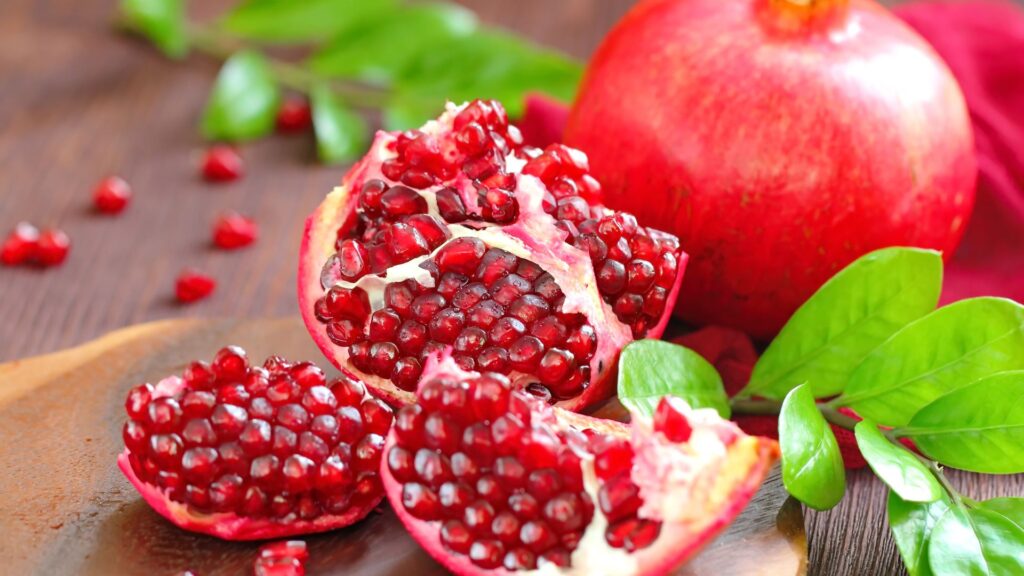
If you want to enjoy what pomegranate does, it helps to know its season, how to choose it and how to get the seeds out. It is a fruit loved for its red seeds, shining like rubies, and its sweet-sour flavour.
Japanese fruit in season in autumn, processed pomegranate all year
Japanese pomegranates come ready in autumn, around October to November. They are often planted as garden trees, and in autumn the fruit ripens until the skin splits of its own accord and the red seeds show through. Fresh pomegranates imported from California and Iran also appear from autumn into early winter. Processed pomegranate, as juice, grenadine syrup and dried seeds, is available all year, so you can have the flavour even when there is none in the shops.
How to choose good pomegranates
When choosing pomegranates, these are the things to look for if you want juicy ones.
- A real weight in the hand
- A firm, glossy skin of a deep colour
- A slightly angular look, a sign that the seeds inside are packed and ripe
A firm fruit holds far more juice than one whose skin has dried and gone rough. If you can see inside through a split, choose one whose seeds are deeply coloured and tightly packed. Avoid any that have split widely and dried out, as the flesh may have spoiled.
How to get the red seeds out cleanly
What you eat of a pomegranate is the juicy red seed coat around each seed. The juice sprays easily, so working under water keeps your clothes clean. The steps are these.
- Score the skin shallowly and break the fruit into several pieces
- In a bowl of water, work the seeds free with your fingers
- The white membrane floats and the heavy seeds sink, so separate them through a sieve
Halving the fruit and tapping the skin side with the back of a spoon to knock the seeds out is easy too. The seeds you take out can be eaten as they are or scattered over a dish.
How to eat pomegranate
The sweet-sour flavour and vivid red of a pomegranate are good on their own and good as a note in cooking. Here is how it fits the everyday table, from drinks to salads.
As they are, as juice and in smoothies
The simplest way to enjoy the seeds is to eat them as they are. The popping texture and the sweet-sour juice spread through the mouth. Squeezed, they make a juice, easy to drink cut with soda or with a little honey. Added whole to a smoothie they bring a sweet-sour note and a red colour, for a sharply flavoured glass. The seeds themselves can be eaten, but if their texture bothers you, squeezing out only the juice gives a smoother result.
As a topping for salads and yoghurt
Scattered over a dish, the red seeds work as a note of colour. Over a green salad, a prosciutto carpaccio or a marinade of white fish, their sweet-sour note sharpens the flavour. On a dairy dessert such as yoghurt, ice cream or panna cotta, the contrast of acidity and texture is a pleasure. Pomegranate syrup, or grenadine, simmered down from the juice, is also used to colour drinks and confectionery. In the Middle East and around the Mediterranean, near where the fruit comes from, the seeds have long been an everyday ingredient, scattered over meat dishes, pilaf and dips. A pinch scattered over a finished dish is all it takes to brighten the table.
How to keep pomegranates
A whole pomegranate keeps about two weeks in a plastic bag, to stop the skin drying, in the vegetable drawer of the fridge. Once the seeds are out, keep them in an airtight container in the fridge and eat them within a few days. If you cannot finish them, spread the seeds flat in a freezer bag and freeze them, ready to go straight into yoghurt and drinks. Dried pomegranate is sold too, and suits topping cereal and baking. For an easy way to bring it in, see how to choose dried fruit is worth reading alongside.
Alongside this, one likewise in season in autumn and held to moisten the body, The benefits of pear or The benefits of persimmon as a guide when building an autumn table.
In season in autumn, pomegranate is a fruit whose sweet-sour seeds are good eaten as they are and good in juice, in salads and as colour on a dessert. Learn the trick of working the seeds out under water and it is not difficult to handle. Bring that vivid red to the table in its season.