The benefits of turnip
Links on this page include advertising.
 What turnips do
What this vegetable does
It is held to settle the circulation of qi and to improve the way the gut works.
How to eat it
Simmered or lightly pickled, it gives you its gentle flavour.
A yakuzen note
It is held to settle the gut and to clear excess damp from the body.
Turnip is looked to for easing the circulation of qi in the body and settling the way the gut works. It is worth bringing in particular when digestion is poor or the stomach feels tight. It also clears excess damp from the body, which suits those for whom swelling is a concern. Simmered or lightly pickled, you get the gentle flavour a turnip has of its own.
TOC
When turnips are in season, their types, and how to choose them
If you want to enjoy what turnip does, it helps to know its season, its types and how to choose it. Juicy, and melting in the mouth once cooked, it is a vegetable where both root and leaves can be eaten.
In season in spring and in autumn and winter, with both leaves and root usable
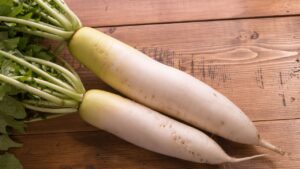
Turnips have two seasons. In spring, around March to May, soft and juicy turnips come in, long familiar as suzuna, one of the seven herbs of spring. In autumn and winter, around October to December, the cold brings up the sweetness and simmering turns them meltingly good. Not only the white root but the green leaves can be eaten: the root for salads and simmered dishes, the leaves for miso soup and stir-fries. Small turnips are what mostly reach the shops, but there are distinctive regional varieties too, large turnips and red ones among them.
Small turnips, Shogoin turnips and red turnips
Turnips come in different sizes and colours, and you can choose to suit the dish.
| kinds | What stands out |
|---|---|
| Small turnip | The most common white turnip. Soft, and easy to use raw or cooked |
| Shogoin turnip | The large Kyoto turnip. Fine-grained, and known for senmaizuke |
| Red turnip | A red-skinned variety. For sweet-vinegar pickles and pickles that play to the colour |
Small turnips for everyday use, and for a refined pickle or simmered dish, the Kyoto vegetable Shogoin turnip, and red turnip when you want the colour: you can choose by use. Across the country there are many traditional turnips used for pickles, such as the Hida red turnip and the Hinona turnip.
How to choose them, and what to do with the leaves
When picking out good turnips, these are the things to look for.
- A round, firm, glossy white root with a real weight to it
- Few whiskery roots, with a juicy cut at the base
- If the leaves are attached, a deep green and full of life
With the leaves still on, they draw water from the root and it spoils faster. Cut the leaves off as soon as you get them home and store root and leaves separately, and both keep their freshness. The skin is soft, so if it is thin you can use it unpeeled, and if the fibre bothers you, or for a simmered dish, peeling it thickly gives a better result in the mouth.
How to eat turnips
Turnip changes face with the cooking, from a crisp bite raw to a melting softness once heated. Here are the usual ways.
Lightly pickled, as senmaizuke and in salads
Sliced thin and salted as a light pickle is the easiest way to have a turnip. Steeped in sweet vinegar it makes a clean palate cleanser, and a large turnip such as Shogoin sliced thin and layered with kombu gives you something close to the senmaizuke of Kyoto. Sliced thin and raw, dressed with olive oil and salt as a salad, or with fruit in the style of a carpaccio, the juiciness comes forward.
Simmered, in miso soup and sauteed
Cooked, turnip gains sweetness and turns meltingly soft. Simmered in stock under a minced-meat sauce, or simmered together with fried tofu, it makes a gently flavoured standard. In miso soup or a potage you get a smooth mouthfeel. Browned in butter and sauteed, or served as a steak, the toasted note and the sweetness come forward. The leaves you cut off can be chopped into miso soup, a stir-fry or a green rice, and nothing is wasted.
How to keep turnips
The basic rule with turnips is to separate leaves and root before storing. Keep the root in a plastic bag in the vegetable drawer of the fridge and use it up soon. The leaves dry out easily, so wrap them in damp kitchen paper before bagging them, and use them soon as well. If you cannot eat them straight away, cut the root into pieces, blanch it on the firm side and freeze it, ready for simmered dishes and soups. Over time the inside goes spongy, what is called su, so enjoy them while they are fresh.
Alongside this, a fellow brassica likewise held to aid digestion, The benefits of daikon radish and the page introducing the Kyoto vegetables of autumn, Kyoto vegetables in autumn as a guide when building a seasonal table.
In season in spring and in autumn and winter, turnip is a useful vegetable where root and leaves alike can be used, across light pickles, senmaizuke, simmered dishes, miso soup and sauteing. Everyday small turnips, refined Shogoin turnips and colourful red turnips: use each type for the job and it shows its best. As a dish for when you want to be kind to the gut, bring turnips in season to the table.
Dried turnip is handy to keep in the cupboard too
No washing and no cutting: just drop it into hot water and it is ready. If you would like a little every day, do try dried turnip.