The benefits of mango
Links on this page include advertising.
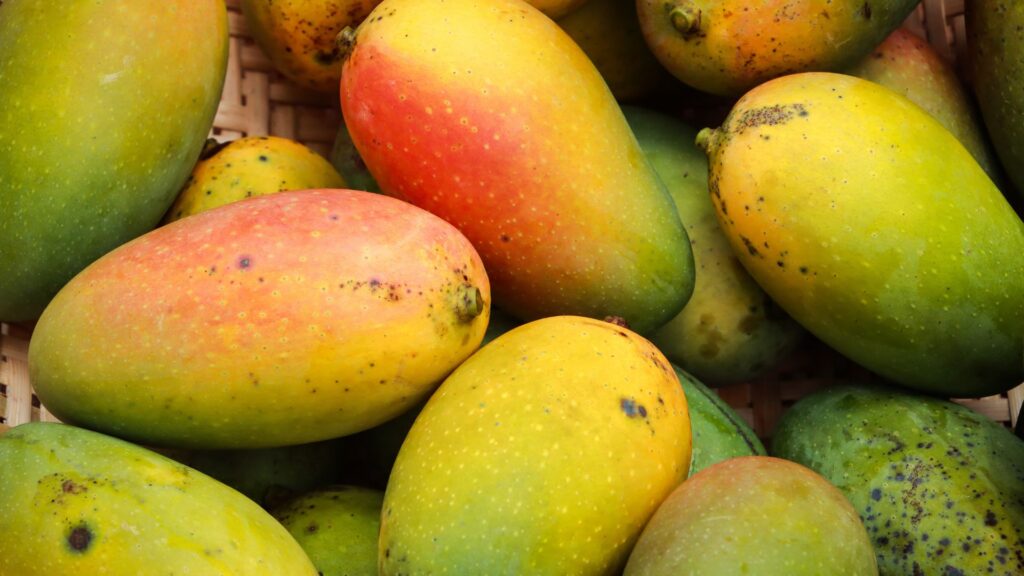 What mangoes do
What this vegetable does
Held to clear excess heat and ease a dry throat, which helps in managing how you feel through the hot season.
How to eat it
As well as eating it as a dessert, adding it to a smoothie or a salad raises the nourishment.
A yakuzen note
Mango is said to clear heat from the body and ease a dry throat, a fruit exactly right for summer.
Mango is sweet and sour and cool in nature, held to settle excess heat trapped in the body, moisten a dry throat and help the stomach work. Its appeal is a rich sweetness and soft flesh, and it suits daily care when you want something for the hot season. As well as eating it as it is, this tropical fruit is easy to use in smoothies, with yoghurt and in salads.
TOC
When mangoes are in season, the kinds, and how to choose
If you want to bring in what mangoes do, deliciously, knowing the season, the kinds and how to choose makes them easier to use. Their appeal is soft flesh and a sweet aroma, and they are a tropical fruit in season in summer.
Japanese from early summer into summer, imported all year
Mango is a fruit of the sumac family, grown in warm regions. Japanese mangoes, from Miyazaki and Okinawa, are in season from early summer into summer, roughly April to August, fully ripe and sweet. Mangoes imported from Mexico, the Philippines and Thailand are in the shops all year. Freshly picked, the flesh is often firm, so it is a fruit left at room temperature for a few days to ripen before eating. How to tell when it is ready is covered under choosing, below. The stone is large and flat, so cut around it.
Apple mango and pelican mango
Mangoes vary in colour, shape and taste by variety.
| kinds | What stands out |
|---|---|
| Apple mango | A variety that colours red. Irwin and the like. Richly sweet. Common in Japan |
| Pelican mango | Yellow and slim. Common from the Philippines. A clean sweetness |
| Keitt mango | A variety that ripens while still green. Large, with a rounded taste |
For a rich sweetness, red-colouring apple mango; for something clean, yellow pelican mango. The Keitt mango ripens while green, so ripeness is hard to judge by eye; go by aroma and give. Choosing by taste and by use brings out what mango has.
How to choose it and how to cut it
When choosing a good mango, these points make it easier to tell.
- A taut, glossy surface, without wrinkles
- Plump and rounded, with a sweet aroma starting to rise (ready to eat)
- Not too many black spots, and undamaged
Mango is often firm when you buy it, so ripen it at room temperature before eating. Once a sweet aroma rises and it has a little give, it is ready. Chilling it in the fridge two or three hours before eating brings the taste forward. To cut it, avoid the flat stone, slice off the flesh on either side, score it in a grid and push it inside out, which makes it easy to eat and good to look at.
How to eat mangoes
Mango works as it is, of course, and in desserts and cooking, drawing on its rich sweetness and soft flesh. Here are the standard ways.
As it is, with yoghurt, or in a salad
What brings out the most in a mango is eating it well chilled, as it is. Scored and pushed inside out, then scooped with a spoon, its soft sweetness is a pleasure. Cut into bite-sized pieces over yoghurt, it suits breakfast or a snack. In a salad with cured ham, mozzarella and leaves, its sweetness and acidity give an accent for a dish that tastes of summer. A fully ripe mango is a feast in itself, so start by enjoying it as it is.
In smoothies and sorbets
Mango goes well in cold desserts too. Blended with milk or yoghurt it makes a smooth smoothie or a mango lassi. Crushed and frozen, it makes a sorbet, exactly right as a snack on a hot day. Cut into bite-sized pieces and frozen, it is good eaten half-thawed. An over-ripe mango whose flesh has softened works in a smoothie or a sorbet, where its sweetness can be used with nothing wasted.
How to keep mangoes
The basic rule is to ripen mango at room temperature until it is ready. The fridge stops it ripening, so leave it out while firm. Once ready, move it to the fridge and eat it soon. Cut mango spoils easily, so wrap it in cling film or put it in an airtight container in the fridge and eat it the same day. If you cannot eat it all, cut it into bite-sized pieces and freeze it, ready for smoothies and sorbets.
Alongside this, it is worth knowing about The benefits of melon likewise held to settle excess heat in the body and moisten a dry throat, and a fellow tropical fruit, The benefits of lychee as a guide when building a summer table.
Mango, in season from early summer into summer, is a tropical fruit whose rich sweetness you can enjoy as it is, with yoghurt, in a salad, in a smoothie or as a sorbet. Rich apple mango, clean pelican mango: choosing by taste and by use brings out what each has. For daily care in the season when heat builds up inside, bring mango to your table.